
UX Design / Feature Design / Mobile / User Research / Figma
Spotify Bridge
Designing a native social sharing and messaging experience for Spotify — keeping music discovery inside the app where it belongs.

THE PROBLEM.
Spotify users share music constantly — but almost never through Spotify itself. They screenshot and post to Instagram stories. They send links over text. They tweet. Every one of those actions breaks the in-app experience, sends users to a different platform, and buries shared music in timelines full of unrelated content.
The result: music shared through third-party channels gets overlooked. Users who want to express themselves through music, introduce friends to new artists, or discover what the people they trust are listening to — don't have a good way to do any of it inside Spotify.
THE RESEARCH.
Before opening Figma, I wanted to understand why people share music at all — not just how. Secondary research pointed to two driving forces: music as identity expression, and music as social bonding. People share music because it communicates who they are and because shared listening creates genuine connection. These aren't casual behaviors — they're psychologically rooted.
I then interviewed six Gen Z Spotify users to pressure-test those findings against real behavior. What I found confirmed the research and added sharper detail:
Users loved Spotify's interface and used its few social features — collaborative playlists, listening parties, Spotify Blends — but found them limited. When it came to sharing music outward, Instagram stories were the most common method, followed by text messages. Nobody was using Snapchat or Facebook.
The key insight came from how users felt about each method. Instagram sharing felt performative and unrewarding — posts got lost in feeds, engagement was low, and most followers weren't there for music. Text message sharing felt more personal and more effective — but clunky, because the music lived in a different app.
One user put it directly: "Realistically, I usually won't leave Instagram to listen to music that people post on their stories. If I saw them post it directly through Spotify, I'd definitely be more inclined to give it a shot."
That tension — intimate sharing works, social sharing doesn't, and neither happens inside Spotify — defined the design challenge.

THE DESIGN CHALLENGE.
How might Spotify enhance its mobile platform to allow for increased interaction and easier content discovery between users — without disrupting the existing experience or overwhelming users with new complexity?
Three principles guided every decision:
Keep it familiar. Don't reinvent Spotify — extend it. Use existing components, existing navigation patterns, existing aesthetic.
Keep it integrated. Nothing should feel bolted on. Every new feature should feel like it was always there.
Keep users in the app. The entire problem is that music sharing sends people elsewhere. The solution has to solve for that.
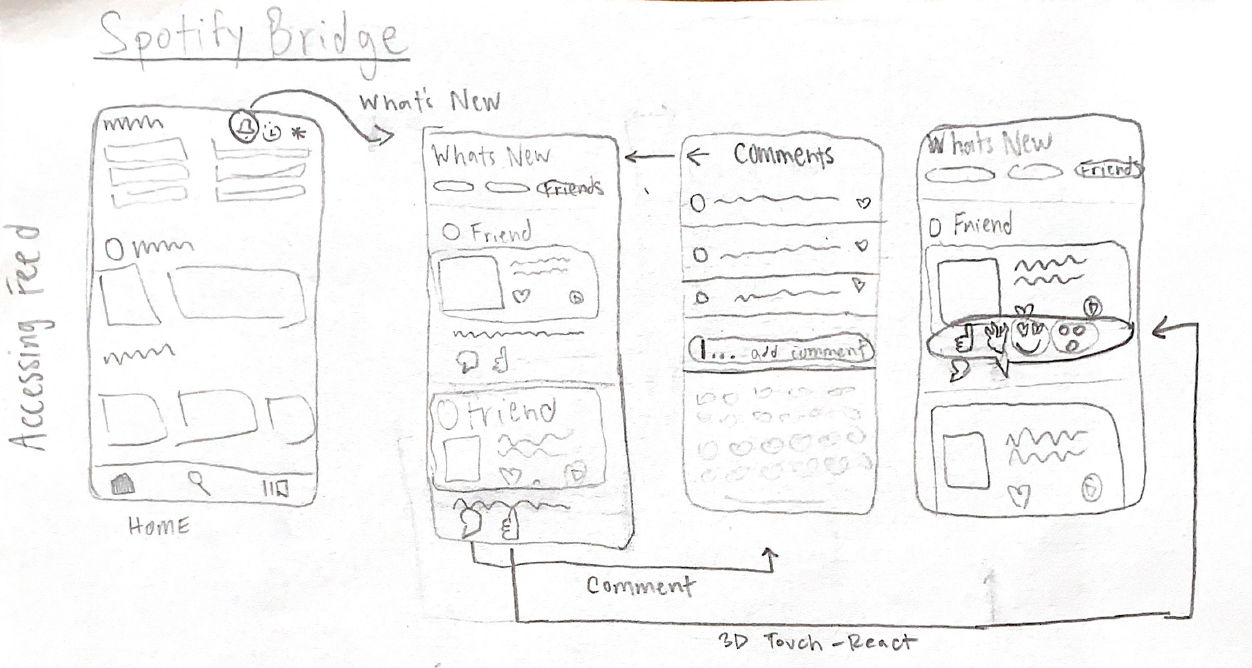
Early concept sketches — exploring navigation placement and initial user flow before moving to digital wireframes.

THE SOLUTION.
Spotify Bridge introduces two complementary features — a social feed and native direct messaging — both built using existing Spotify components and integrated into existing navigation tabs.
The Feed — Housed within Spotify's existing "What's New" tab, the Bridge feed gives users a dedicated space to share music with their followers — songs, albums, artists, playlists — with captions that let them express the sentiment behind the share. Posts are likeable and commentable. Shared music is one tap away from playing. The feed doesn't take over the app — it lives within an existing tab, making it easy to find without being impossible to ignore.

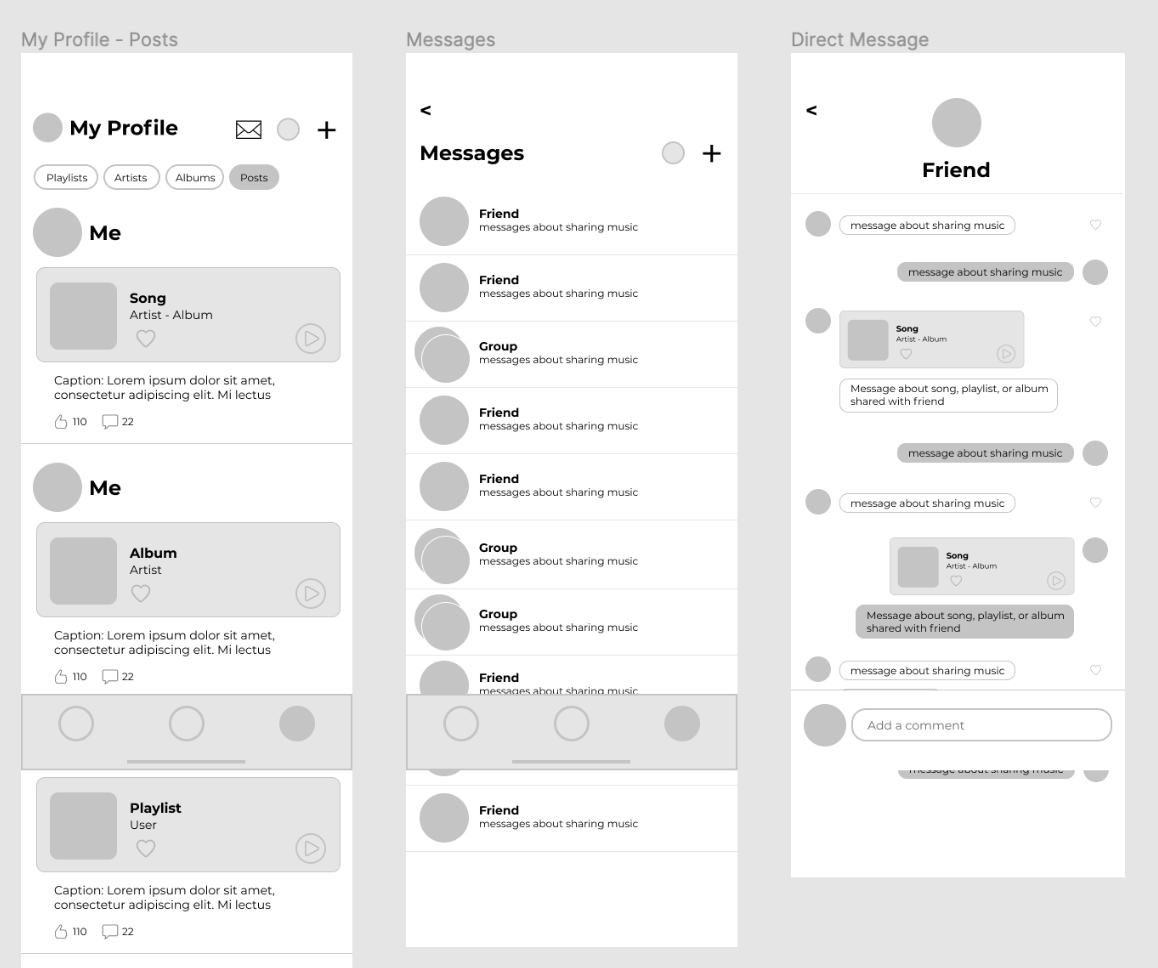
Direct Messaging — Accessible through a mail icon in the "My Library" tab, Spotify Bridge DMs let users share music directly with individual friends or group chats — the intimate, personal sharing experience that users said worked best, now native to Spotify. The same card-style media blocks used in the feed create visual consistency throughout.
Post Creation — Creating a post is integrated directly into Spotify's existing share flow — the "Create a Post" option appears alongside the existing sharing options when a user wants to share a track. No new surface, no new habit to learn.

High-fidelity prototype — final screens showing the Bridge feed, direct messaging, and post creation flow.
VALIDATION.
After building the high-fidelity prototype, I brought it back to the original interviewees. The response was clear across all three goals.
On discovery — users agreed that a native feed would meaningfully improve peer-to-peer music discovery. Seeing shared music in a space designed for music made engagement feel natural rather than incidental.
On sharing — users felt the integrated DMs solved the intimacy problem. Sharing music directly through Spotify felt more intentional than a text link, and more personal than a public story.
On retention — users said the social layer would give them more reason to stay in the app. One put it simply: "Like any other social media, I would definitely want to keep up with my timeline."
The hypothesis held: native sharing spaces improve discovery, generate more meaningful responses to shared music, and keep users inside Spotify.
CONTEXT.
This project was completed as part of the IxDF UX Portfolio & Career Bootcamp in 2022. It was a solo concept project — I handled all research, design, and validation. It was subsequently published in Bootcamp on Medium.