
UX Design / Mobile App / Branding / Adobe XD / Senior Capstone
Peep — Web Store Reviews
Designing a Yelp-style platform for discovering and reviewing online clothing stores — from brand identity and user research through a fully interactive prototype.

THE PROBLEM.
Online shoppers are overwhelmed by options. There are hundreds of web stores selling clothing and almost no reliable way to know which ones are worth trusting before you buy. Sizing inconsistencies, poor material quality, delayed shipping, bad customer service — these are common experiences, but the tools to research stores before committing don't really exist. Reviews are scattered, influencers are paid, and the platforms designed for discovery weren't built with fashion shoppers in mind.
MY ROLE.
Peep was my senior capstone project at the University of Florida, completed as the final requirement of the Digital Arts & Science program. I owned the entire project — defining the concept, conducting research, developing the brand identity, designing the full user flow, building wireframes, and delivering a high-fidelity interactive prototype in Adobe XD. The project was presented to faculty and classmates, and feedback from that presentation informed the final direction.
THE RESEARCH.
I started by talking to college-aged online shoppers in my target demographic — people who regularly bought clothing from web stores and had strong opinions about the experience. Conversations consistently surfaced the same frustrations: no reliable way to know if a store was trustworthy before ordering, sizing that varied wildly between stores, and no central place to find honest peer reviews.
Competitive analysis shaped the solution. Yelp showed how community-driven reviews could build trust at scale. Reddit showed how message boards create organic, peer-driven conversations that go deeper than a star rating. Neither platform was designed for fashion-specific web store discovery — which defined Peep's opportunity.
Two principles guided everything from there: peer trust matters more than brand marketing when making purchase decisions, and community discussion adds context that ratings alone can't provide.
THE USER.
Joe, a college student shopping online for clothes — overwhelmed by options, looking for stores he can trust.

THE BRAND.
Peep needed a visual identity that felt trustworthy, clean, and contemporary — something that could sit alongside apps like ASOS or Depop without feeling out of place. I designed the full brand system from scratch: logo, color palette, and typography.
The name "Peep" plays on the dual meaning — peeking at stores before committing, and the social connection between shoppers. The visual identity uses a deep navy and medium blue palette to signal reliability and clarity, with Montserrat as the primary typeface for its clean, modern readability across mobile screens.

THE USER FLOW.
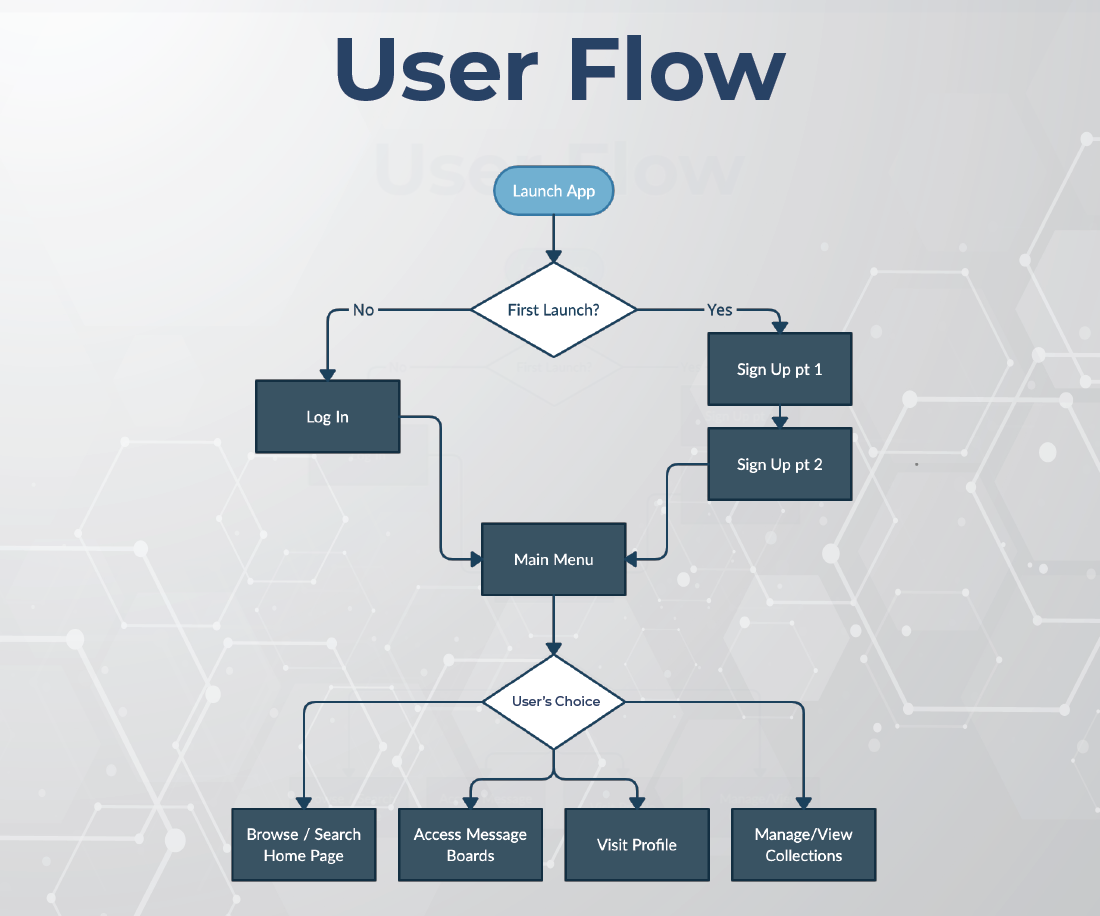
Before designing any screens I mapped the complete user flow — from first launch through every major path a user could take through the app. The flow branches at first launch: new users move through a two-step sign-up process, returning users log in directly. Both paths converge at the main menu, from which users can browse the home page, access message boards, visit their profile, or manage collections.
Mapping this before wireframing ensured that every screen had a clear place in the architecture and that navigation between sections was logical and consistent.
WIREFRAMES.
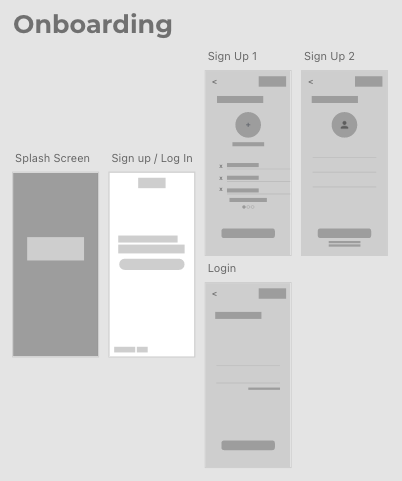
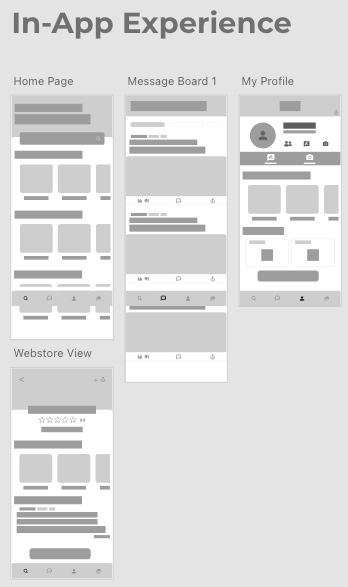
I wireframed two distinct flows: the onboarding experience and the core in-app experience.
The onboarding flow covers the splash screen, sign-up across two steps, and login — designed to collect only the information necessary to personalize the app without overwhelming new users at the door.
The in-app wireframes cover the four primary sections of Peep: the home page for store discovery, the message board for community discussion, the profile page for tracking review history and impact, and the individual store view for ratings and reviews.
THE SOLUTION.
Peep is a mobile app with four core sections, each designed to serve a distinct part of the shopping research experience.
Home — The discovery engine. Users see trending stores, category-based browsing, and personalized recommendations based on their activity and preferences. Top-rated stores surface naturally, giving casual browsers immediate value.
Collections — Users can save items spanning multiple web stores into curated collections organized by theme or occasion. This feature addresses the way fashion-conscious shoppers actually browse — not store by store, but by building outfits and aesthetics across multiple sources.
Message Board — Inspired by Reddit, the message board gives users a space to have conversations about web stores beyond the constraints of a star rating. Users can post, share experiences, and respond to others — creating a community layer that makes the platform stickier and more useful over time.
Store View & Reviews — The core utility. Each store has its own page with an aggregate rating, popular items, recommended reviews, and a "Write a Review" option. Users can rate stores and add photos, creating a growing body of peer-generated trust signals.

Profile — Users can see their review history, track their impact score, and view recently browsed stores. The impact metric — votes and views on their reviews — gamifies contribution and encourages users to keep reviewing.
THE RESULT.
Peep was presented as a complete UX deliverable to faculty and classmates at the University of Florida. Feedback validated the core concept — particularly the message board feature, which resonated as a meaningful differentiator from existing review platforms — and affirmed the visual identity as polished and production-ready.
The project demonstrated the full UX process from problem definition through high-fidelity delivery, including brand development, competitive research, user flow mapping, wireframing, and interactive prototyping.
CONTEXT.
Senior capstone project completed as part of the B.A. Digital Arts & Science program at the University of Florida, 2021. Solo project — all research, design, and production handled independently.
Tools: Adobe XD, Photoshop, Illustrator